Global Vegan Protein Powder Market
Global Vegan Protein Powder Market Size Study and Forecast, 2026-2036

Report Summary
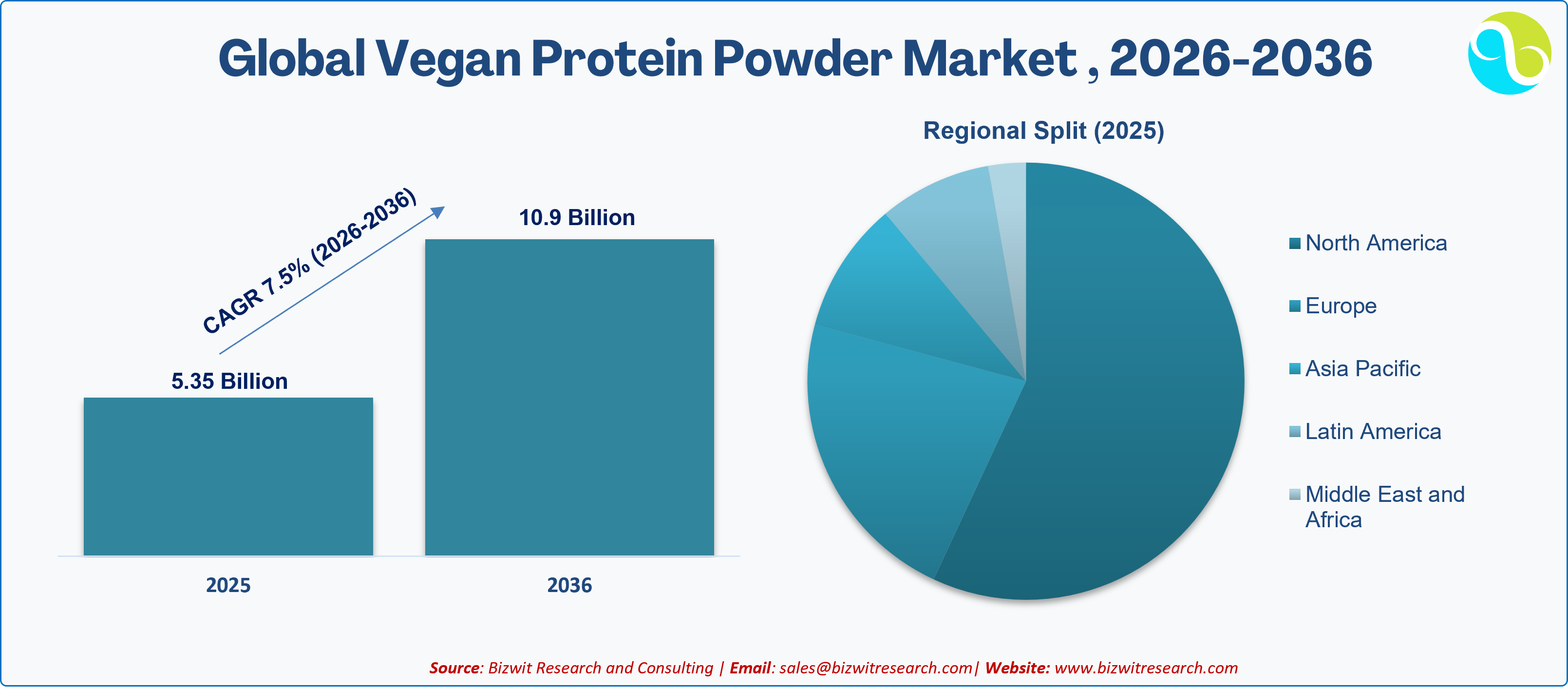
The global vegan protein powder market, valued at USD 5.35 billion in 2025, is projected to reach USD 10.9 billion by 2036.
Category: Food and Beverages
Report Code: BIZ260836
Pages: 293
Published:
Pricing
- Single User License: $4950
- Enterprise License: $6250
- Excel Data Pack: $2950
Report Details
Market Definition, Recent Developments and Industry Trends
The global vegan protein powder market, valued at USD 5.35 billion in 2025, is projected to reach USD 10.9 billion by 2036, growing at a CAGR of 7.5% over the forecast period 2026 to 2036. The global vegan protein powder market encompasses plant-derived protein supplements formulated from sources such as peas, hemp, soy, rice, and algae. Consumers seeking sustainable, allergen-friendly, and ethically produced protein alternatives widely use these products across dietary supplementation and sports nutrition applications. The market ecosystem includes raw material suppliers, ingredient processors, contract manufacturers, branded nutrition companies, and distribution platforms spanning both offline retail and digital channels.
Recently, the market has transitioned from a niche health-conscious segment to a mainstream nutritional category, driven by the convergence of veganism, fitness culture, and clean-label consumption. Advances in protein extraction technologies and flavor masking techniques have significantly improved taste, texture, and bioavailability, addressing earlier consumer concerns. Additionally, regulatory support for plant-based products, growing awareness of environmental sustainability, and the expansion of e-commerce have accelerated global penetration. Looking ahead, innovation in blended proteins and algae-based formulations is expected to redefine performance nutrition standards during the forecast period.
Market Determinants
The growing global shift toward vegan and flexitarian lifestyles is a primary growth driver. Consumers are actively replacing animal-based proteins with plant-derived alternatives due to ethical, environmental, and health considerations, directly boosting demand for vegan protein powders.
The growing fitness and wellness industry has significantly expanded the addressable market. Vegan protein powders are increasingly being adopted by athletes and fitness enthusiasts seeking clean-label, lactose-free, and easily digestible protein sources, thereby enhancing market penetration.
Continuous innovation in protein isolation, enzymatic processing, and flavor enhancement technologies has improved product palatability and nutritional profiles. These advancements are critical in overcoming historical barriers related to taste and texture, enabling broader consumer acceptance.
Heightened concerns around carbon emissions, water usage, and animal welfare are pushing both consumers and manufacturers toward sustainable protein solutions. Plant-based proteins, particularly pea and hemp, offer lower environmental footprints, reinforcing their commercial appeal.
Despite strong growth prospects, relatively higher pricing compared to conventional protein powders and volatility in raw material supply can limit adoption in price-sensitive markets. Supply chain disruptions and dependency on agricultural yields further pose operational challenges.
Opportunity Mapping Based on Market Trends
Blended protein formulations combining multiple plant sources are emerging as a key opportunity, offering improved amino acid profiles and enhanced functionality. Companies investing in performance-oriented formulations can capture premium market segments.
Algae-based proteins such as spirulina present a high-growth niche due to their superior nutrient density and sustainability credentials. As consumer awareness increases, these innovative sources are expected to gain traction in specialized nutrition segments.
The rapid growth of online distribution channels provides significant opportunities for brand differentiation and consumer engagement. Direct-to-consumer models enable companies to build brand loyalty, offer personalized nutrition solutions, and optimize margins.
Expanding into the Asia Pacific and LAMEA regions offers untapped growth potential driven by rising disposable incomes, urbanization, and increasing health awareness. Localization of flavors and pricing strategies will be critical to success in these markets.
Report Attributes | Details |
Market Size in 2025 | USD 5.35 Billion |
Market Size by 2036 | USD 10.9 Billion |
CAGR | CAGR of 7.5 % From 2026 to 2035 |
Base Year | 2025 |
Forecast Period | 2026-2035 |
Historical Data | 2022-2024 |
Key Segments |
|
Regional Analysis/Coverage | North America (US, Canada), Europe (Germany, UK, France, Italy, Spain, Rest of Europe), Asia Pacific (China, India, Japan, South Korea, Australia, ASEAN Countries, Rest of Asia Pacific), Middle East & Africa (UAE, Saudi Arabia, Qatar, South Africa, Rest of Middle East & Africa), Latin America (Brazil, Argentina, Mexico, Colombia, Rest of Latin America). |
Company Profiles | MuscleBlaze, Nutricore Bioscience Pvt. Ltd., Fz Nutrition, Healthoxide Vegan Plant Protein, Nutralike Health Care/ Nutralike Formulation Pvt Ltd, Amway India, Bigmuscles Nutrition, KOS Organic Plant Protein, Myfitfuel Plant Pea Protein Isolate, Naked Nutrition, Nutrilite Protein, Paradise Nutrition Inc, Orgain Organic Protein Plant-Based Powder, Naked Pea Protein Farms, Nutrilite Protein, Vega Sport Premium Protein, Garden of Life Raw Organic Protein, Ghost Whey Protein, Optimum Nutrition Gold Standard Whey, Organic India Protein, Plant Protein, Vega Protein Greens, and Makers Nutrition |
Value-Creating Segments and Growth Pockets
Pea protein currently dominates the market due to its favorable amino acid profile, cost-effectiveness, and widespread consumer acceptance. Soy protein continues to hold relevance, particularly in mature markets, due to its established supply chain and nutritional completeness. However, protein blends are expected to witness the fastest growth, driven by increasing demand for optimized nutrition and improved taste profiles.
From an application perspective, dietary supplements account for a significant share owing to their broad consumer base, while sports nutrition is anticipated to grow at a faster pace as plant-based performance products gain credibility among athletes. In terms of distribution, offline channels remain dominant, but online platforms are rapidly emerging as high-growth avenues due to convenience, wider product availability, and targeted marketing.
Regional Market Assessment
North America
North America leads the market, supported by high consumer awareness, a well-established fitness culture, and strong presence of leading plant-based nutrition brands. Innovation and premium product adoption are key growth drivers in this region.
Europe
Europe demonstrates steady growth driven by stringent environmental regulations, rising vegan population, and strong demand for sustainable food products. Regulatory alignment with clean-label trends further supports market expansion.
Asia Pacific
Asia Pacific is expected to register the fastest growth due to increasing urbanization, rising disposable incomes, and growing health consciousness. The region also benefits from a large vegetarian population and expanding e-commerce infrastructure.
The LAMEA region presents emerging opportunities driven by gradual lifestyle shifts and increasing awareness of plant-based nutrition. However, market growth may be moderated by lower consumer awareness and price sensitivity in certain countries.
Recent Developments
- March 2024: A leading nutrition brand launched a multi-source vegan protein blend targeting sports performance, highlighting the shift toward functional and hybrid formulations.
- September 2023: A major plant-based company expanded its e-commerce distribution network globally, strengthening direct-to-consumer capabilities and market reach.
- June 2023: An ingredient manufacturer invested in algae-based protein production, signaling increased industry focus on sustainable and novel protein sources.
Critical Business Questions Addressed
- What is the long-term growth trajectory of the vegan protein powder market, and where will value creation be concentrated?
Understanding market size evolution and key revenue pools enables stakeholders to align investment strategies.
- Which protein sources and formulations should companies prioritize?
Identifying high-growth segments such as protein blends and algae-based proteins helps refine product development strategies.
- How are distribution dynamics evolving across regions?
Assessing the shift toward online channels informs go-to-market and customer acquisition strategies.
- What are the key competitive differentiators in this market?
Insights into innovation, branding, and sustainability positioning help companies strengthen market presence.
- What regional strategies are critical for expansion?
Understanding region-specific demand drivers supports targeted market entry and localization efforts.
Beyond the Forecast
The vegan protein powder market is poised to evolve beyond traditional supplementation into a broader functional nutrition ecosystem, driven by personalization and performance optimization.
Sustainability will remain a defining competitive factor, with companies increasingly integrating transparent sourcing and environmentally responsible production practices.
Long-term success will depend on the ability to innovate across formulations, leverage digital channels, and align with shifting consumer expectations around health, ethics, and environmental impact.