Global Medical Equipment Maintenance Market
Global Medical Equipment Maintenance Market Size Study and Forecast, 2026-2035

Report Summary
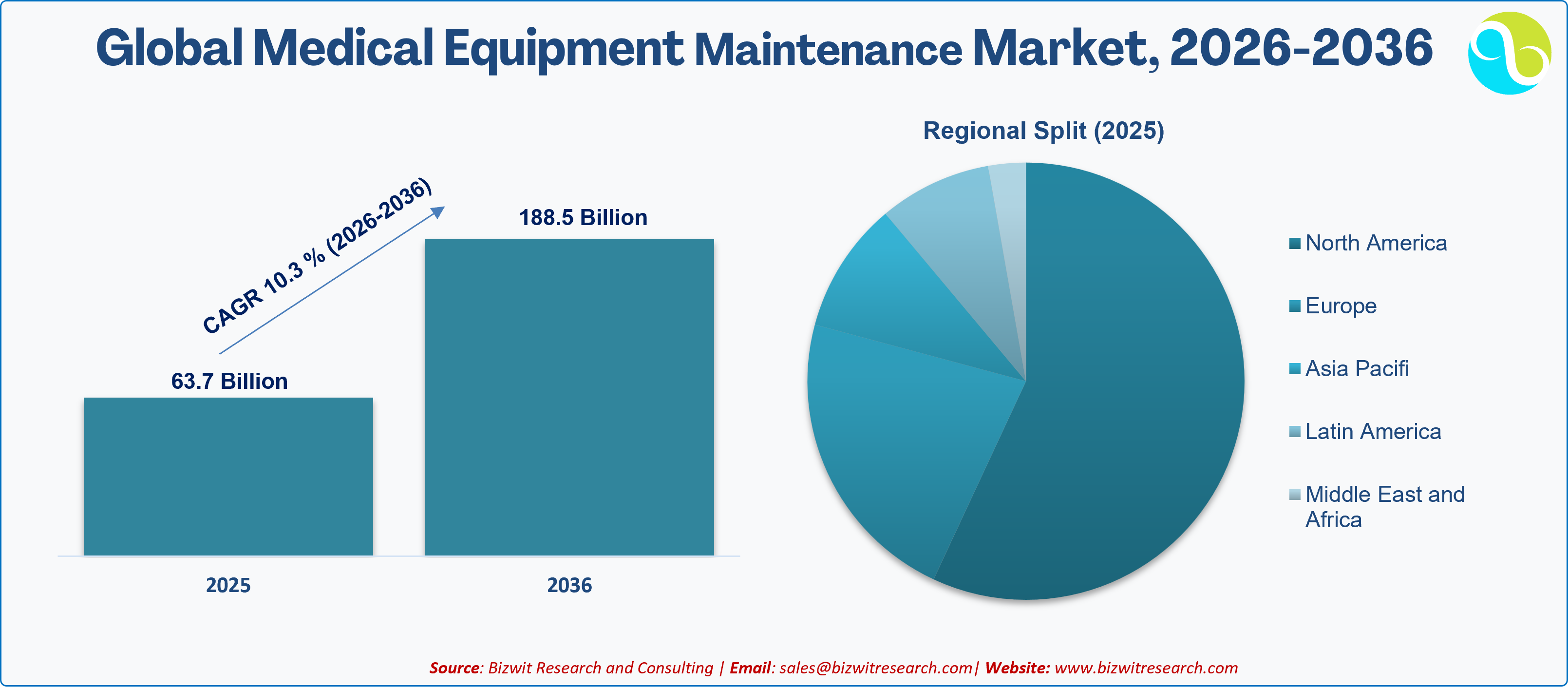
The global medical equipment maintenance market is estimated at USD 63.7 billion in 2025 and is projected to reach approximately USD 188.5 billion by 2036.
Category: Healthcare and Life Sciences
Report Code: BIZ260665
Pages: 293
Published:
Pricing
- Single User License: $4950
- Enterprise License: $6250
- Excel Data Pack: $2950
Report Details
Market Definition, Recent Developments and Industry Trends
The global medical equipment maintenance market is estimated at USD 63.7 billion in 2025 and is projected to reach approximately USD 188.5 billion by 2036, reflecting a CAGR of around 10.3% from 2026 to 2036. The medical equipment maintenance market encompasses a broad range of services aimed at ensuring the safety, functionality, accuracy, and longevity of medical devices deployed across healthcare facilities. These services include preventive maintenance, corrective repairs, and performance or operational optimization for diverse device categories such as imaging equipment, patient monitoring systems, surgical instruments, and laboratory apparatus. The ecosystem comprises original equipment manufacturers (OEMs), independent service organizations (ISOs), third-party service providers, in-house biomedical engineering teams, and digital maintenance solution vendors.
In recent years, the market has evolved from reactive, break-fix models toward predictive and performance-based maintenance frameworks. Increasing deployment of high-value, technologically complex devices—particularly advanced imaging systems and life support equipment—has elevated the importance of structured maintenance programs. Digital transformation, including remote diagnostics, IoT-enabled monitoring, and AI-driven predictive analytics, is reshaping service delivery models. Regulatory emphasis on patient safety, uptime guarantees, and equipment traceability further reinforces demand for comprehensive service contracts. Over the forecast period 2026-2035, healthcare digitization, expansion of hospital infrastructure in emerging markets, and rising equipment replacement cycles are expected to drive sustained growth.
Market Determinants
Healthcare facilities are increasingly investing in high-cost imaging systems, robotic surgical devices, and advanced patient monitoring equipment. These capital-intensive assets require structured maintenance programs to ensure uptime and regulatory compliance, directly expanding the service revenue pool.
Healthcare providers are prioritizing preventive and performance-based maintenance to minimize downtime and reduce lifecycle costs. Predictive analytics and remote monitoring tools enable early fault detection, lowering emergency repair expenses and enhancing operational efficiency.
Regulatory authorities mandate regular calibration, validation, and documentation of medical equipment performance. Compliance requirements from healthcare accreditation bodies incentivize hospitals and laboratories to enter long-term maintenance contracts, creating stable recurring revenue streams for service providers.
Rising healthcare expenditures are prompting institutions to optimize operating costs. Independent service organizations and multi-vendor maintenance contracts offer cost-effective alternatives to single-vendor OEM agreements, intensifying competition and pricing pressures in the market.
The growing complexity of devices requires specialized technical expertise. Limited availability of trained biomedical engineers and technicians can constrain in-house maintenance capabilities, driving demand for outsourced and technology-enabled service solutions.
Opportunity Mapping Based on Market Trends
Integration of IoT sensors and cloud-based diagnostics enables real-time equipment monitoring and remote troubleshooting. Vendors offering predictive maintenance dashboards and analytics platforms can unlock subscription-based revenue models and reduce on-site service dependency.
Healthcare providers increasingly prefer consolidated contracts covering multiple device brands and categories. Multi-vendor OEMs and independent service organizations can capitalize on this demand by delivering standardized, cost-efficient solutions across heterogeneous equipment fleets.
Rapid hospital construction and modernization initiatives in Asia Pacific, the Middle East, and parts of Latin America create significant opportunities for long-term maintenance partnerships, particularly in newly established tertiary care centers.
With budget constraints influencing capital expenditure, hospitals are extending equipment lifecycles through structured maintenance and refurbishment. Service providers offering performance optimization and mid-life upgrades can capture additional value beyond basic repair services.
Report Attributes | Details |
Market Size in 2025 | USD 67.3 Billion |
Market Size by 2036 | USD 188.5 Billion |
CAGR | CAGR of 10.3 % From 2026 to 2035 |
Base Year | 2025 |
Forecast Period | 2026-2035 |
Historical Data | 2022-2024 |
Key Segments |
|
Regional Analysis/Coverage | North America (US, Canada), Europe (Germany, UK, France, Italy, Spain, Rest of Europe), Asia Pacific (China, India, Japan, South Korea, Australia, ASEAN Countries, Rest of Asia Pacific), Middle East & Africa (UAE, Saudi Arabia, Qatar, South Africa, Rest of Middle East & Africa), Latin America (Brazil, Argentina, Mexico, Colombia, Rest of Latin America). |
Company Profiles | Medtronic (U.S.), Stryker (U. S.), Siemens Healthineers AG (Germany), GE HealthCare (U.S.), Koninklijke Philips N.V. (The Netherlands), Canon Medical Systems Corporation (Japan), Hitachi High-Tech Corporation (Japan), Fujifilm Holdings Corporation (Japan), Shimadzu Corporation (Japan), Agfa-Gevaert N.V. (Belgium), Drägerwerk AG and Co., KGaA (Germany), Carestream Health (U.S.), Aramark (U.S.), Crothall Healthcare (U.S.), Alpha Source Group (U.S.), Alliance Medical Limited (U.K.) |
Value-Creating Segments and Growth Pockets
Preventive maintenance currently accounts for the largest share, as healthcare institutions prioritize compliance and equipment uptime. However, performance/operational services are expected to grow at a faster pace, driven by demand for efficiency optimization and predictive analytics integration.
External service providers dominate in revenue terms due to specialized expertise and scalability. Nevertheless, in-house maintenance models are gaining traction in large hospital networks seeking greater operational control and cost management.
By device type, imaging equipment represents the most significant revenue contributor given its high acquisition cost and technical complexity. Meanwhile, patient monitoring and life support devices are projected to witness strong growth, reflecting expanding critical care capacity and continuous monitoring requirements.
From a technology standpoint, multi-vendor OEMs and independent service organizations are positioned for accelerated expansion as healthcare providers seek flexible, cost-efficient service alternatives to traditional single-vendor contracts.
Regional Market Assessment
North America
North America leads the market, supported by a large installed base of advanced medical equipment, stringent regulatory compliance standards, and widespread adoption of long-term service contracts. Digital maintenance solutions are gaining rapid traction across hospital networks.
Europe
Europe demonstrates strong demand driven by aging populations, healthcare modernization initiatives, and regulatory oversight. Multi-vendor service contracts and cost optimization strategies are increasingly prevalent across public healthcare systems.
Asia Pacific
Asia Pacific is projected to experience the fastest growth, fueled by expanding healthcare infrastructure, rising medical tourism, and increasing adoption of advanced diagnostic technologies. Demand for outsourced maintenance services is particularly strong in emerging economies.
LAMEA presents emerging opportunities, particularly in the Middle East where significant investments in hospital infrastructure are underway. Latin America and parts of Africa are gradually strengthening service ecosystems through partnerships with global OEMs and ISOs.
Recent Developments
- March 2024: A leading OEM introduced an AI-enabled predictive maintenance platform for imaging equipment, enhancing remote diagnostics and reducing equipment downtime across hospital networks.
- November 2023: A major independent service organization expanded its multi-vendor service portfolio through strategic acquisitions, strengthening its position in cost-sensitive healthcare markets.
- July 2023: A hospital consortium in Asia Pacific implemented centralized digital maintenance management systems, improving asset tracking and regulatory compliance across multiple facilities.
Critical Business Questions Addressed
- What is the long-term revenue outlook for medical equipment maintenance through 2035?
The report evaluates growth trajectories across service types, technologies, and regions.
- Which service models deliver the highest operational and financial value?
Comparative insights assess preventive, corrective, and performance-based contracts.
- How is digital transformation reshaping maintenance strategies?
The study analyzes the impact of IoT, AI, and remote monitoring on service efficiency and revenue models.
- What competitive advantages do multi-vendor and independent service providers hold?
The report explores cost dynamics, flexibility, and scalability considerations.
- Which end-user segments offer the most robust growth potential?
Segment-level analysis highlights hospital networks and specialized care centers as key demand drivers.
Beyond the Forecast
The medical equipment maintenance market is transitioning from reactive service provision to data-driven lifecycle management.
Long-term competitive advantage will hinge on digital integration, predictive analytics capabilities, and flexible multi-vendor service ecosystems.
As healthcare systems prioritize operational resilience and cost efficiency, maintenance providers that align technological sophistication with compliance expertise will shape the next phase of industry evolution.