Global Dried Fruit Raw Materials Market
Global Dried Fruit Raw Materials Market Size Study and Forecast, 2026-2036

Report Summary
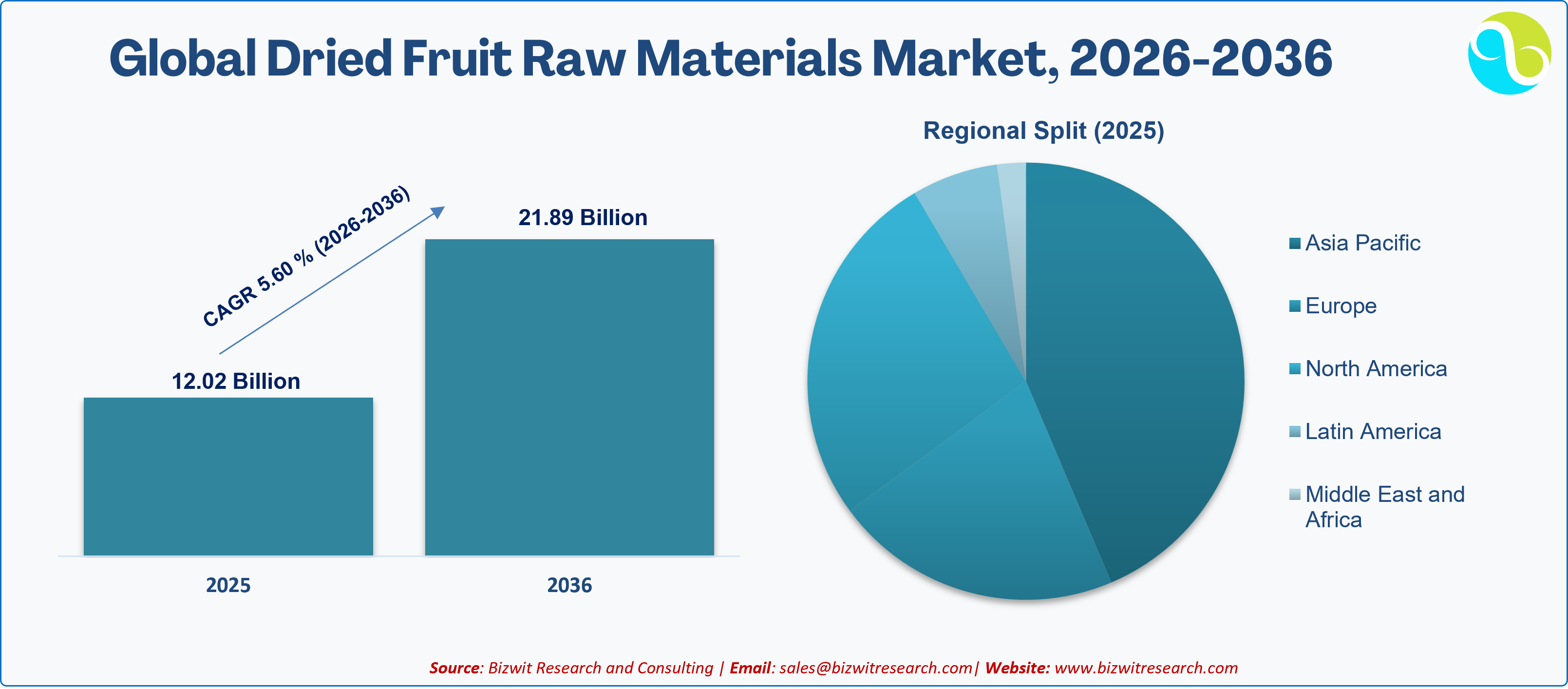
The global dried fruit raw materials market size is valued at USD 12.02 billion in 2025 and is projected to grow at 5.60% CAGR during 2026-2036.
Category: Food and Beverages
Report Code: BIZ260898
Pages: 293
Published:
Pricing
- Single User License: $4950
- Enterprise License: $6250
- Excel Data Pack: $2950
Report Details
Market Definition
Global Dried Fruits Raw Material Market with a valuation of USD 12.02 billion in 2025 is expected to grow to USD 21.89 billion by 2036, recording a CAGR of 5.60% during the forecast period. The market has gone through a significant transformation whereby it has evolved from the simple nature of commodity based agriculture to a well-defined value system that involves food processing, consumer demands, and trade patterns for a holistic business environment. Traditionally, dried fruits provided an effective preservation mechanism in agrarian societies, which had a requirement of dehydrating fruits as a way of preserving the seasonal surplus throughout the year, but the current dynamics involve nutritional needs and various purposes.
However, the raw materials market of dried fruits has experienced an expansion over the past years as a result of the rising global demand for minimally processed food raw materials based on dietary trends that advocate for foods containing natural sugar, fiber, and micro-nutrient contents, and therefore placing dried fruits in the league of premium raw materials used in bakeries, confectionery, dairy, and cereals industries. As per the reports of Food and Agriculture Organization in 2024, fruit production globally stands at above 900 million metric tons per year, with some proportion being used in the process of processing and drying.
With trade liberalization policies and advancements in cold chain transportation technology, there has been an increase in dried fruit raw materials' international transport. As a result, producers in regions like the Middle East, South Asia, and Latin America can now export their products to high-value destinations such as North America and Europe. Such a globalization trend has created stiff competition among firms operating within this industry, coupled with stringent quality standards. The market is highly volatile due to climate change, water scarcity, and rising prices of farm inputs that impact raw materials' prices and production levels.
The Global Dried Fruit Raw Materials Market deals with the growth, harvesting, processing, and distribution of fruits that have undergone dehydration processes to improve storage life and shipping capabilities to serve as raw materials for food processing, retail purposes, and ingredients formulation in various industries. This market covers dried fruits such as grapes, dates, apricots, figs, cranberries, and others.
The various participants in the market include farmers, processing plants, exporters, importers, food manufacturers, distribution companies, and retail outlets, which all form part of a complicated value chain that synchronizes agricultural growing cycles with industrial demand needs. There is also involvement of certifying authorities, food safety organizations, and other regulatory organizations concerned with food safety standards, organic labeling requirements, and export/import regulations.
In terms of the business nature of the market of raw materials for dried fruit products, supply chains play a critical role since what happens upstream impacts on the quality and price of products downstream. Businesses that have implemented vertical integration, innovative drying techniques, and sustainable farming enjoy competitive advantages.
Research Scope and Methodology
In terms of geographical boundaries, the Global Dried Fruit Raw Materials Market study covers a broad range of product classifications, certification systems, and market channels to better understand demand generation factors in relation to the food processing industries, retail consumption, and export segments. The different consumption uses considered include bakery products, snacks, dairy products, and confectioneries - all of which are distinct and based on regional dietary and industrial practices.
The ecosystem includes actors like farmers, cooperative groups, processing plants, exporters, logistics services, regulatory bodies, and end user manufactures - creating an interlinked chain of activities that need to be coordinated along production, processing, and marketing channels. Such interrelation calls for a thorough investigation of the agricultural environment as well as end users' consumption trends.
As part of the methodology, primary research will involve interviewing agricultural produce suppliers, processing firms, export firms, and procurement officers in food processing industries to obtain first hand information about pricing and demand factors. The secondary research will entail reviewing statistical figures from government agricultural data as well as corporate data and industry publications.
For instance, according to the reports by the United States Department of Agriculture released in 2024, the exports of dried fruits in the world were estimated to be worth over several billions of dollars per year. Such findings illustrate the level of demand for dried fruits internationally and the significance of cross-border trading as a critical determinant of market development. In quantitative analysis, the use of statistical models that take into account the levels of production, consumption, export/import figures, and economic conditions is used to estimate the future direction of the market. Scenario analysis assesses the effect of factors like climatic changes, changes in trading policies, and innovations in the drying process technology. Sensitivity analysis helps determine the role played by certain assumptions in predicting the market direction.
Report Attributes | Details |
Market Size in 2025 | USD 12.02 Billion |
Market Size by 2036 | USD 21.89 Billion |
CAGR | CAGR of 5.60% From 2026 to 2035 |
Base Year | 2025 |
Forecast Period | 2026-2035 |
Historical Data | 2022-2024 |
Key Segments |
|
Regional Analysis/Coverage | North America (US, Canada), Europe (Germany, UK, France, Italy, Spain, Rest of Europe), Asia Pacific (China, India, Japan, South Korea, Australia, ASEAN Countries, Rest of Asia Pacific), Middle East & Africa (UAE, Saudi Arabia, Qatar, South Africa, Rest of Middle East & Africa), Latin America (Brazil, Argentina, Mexico, Colombia, Rest of Latin America). |
Company Profiles | AMETEK Inc., Anaheim Automation Inc., Arcus Technology Inc., ElectroCraft Inc., Regal Rexnord Corp. |
Industry Trends
The dried fruits raw materials market shows a significant trend towards a shift towards a healthy consumption pattern, where consumers prefer products made using natural and nutritious ingredients. As such, the demand for dried fruits has grown steadily as a substitute to snacks containing refined sugars and other chemical substances. Consumers are therefore interested in products with clean labels, as they contain minimal processing and use of harmful ingredients.
The trend towards organic products is another important development in this industry, where people prefer paying higher prices for products labeled as being eco-friendly and lacking harmful chemicals. While producers try to embrace organic production systems, certification adds costs and complexity, making it hard to implement on smaller scale.
Drying technology innovations help increase product quality, allowing the maintenance of flavor, color, and nutrients. As a result, these technological advances boost the value of the dried fruit products due to their increased utility life.
The process of supply chain digitization is taking up more significance in terms of market operation, with market participants relying on digitization, traceability through blockchain technology, and data analytics for tracking production, inventory, and distribution operations. Such digitization helps bring about greater transparency, minimize inefficiency, and ensure compliance with global standards of food safety.
The demand coming from the food processing sector remains a major factor contributing to market growth, with processors using dried fruits in the production of various foods ranging from cereals, energy bars, bakery products, and dairy products due to their intrinsic sweetness and nutrients. The reports of Food and Agriculture Organization as of 2024 reveal that demand for processed foods continues growing worldwide, thereby driving the demand for dried fruits.
Market Determinants
Market growth drivers
The increased knowledge and understanding among consumers about the health benefits associated with dried fruits are among the factors that help fuel market growth as people look for nutritious foods.
Demand trends
Changes in consumer preference for convenience foods have resulted in increased demand for fruit ingredients, especially among urban residents who lack enough time to prepare meals.
Enablers of growth
The development of efficient agricultural practices, along with favorable trade policies, helps facilitate growth by making production easier, more affordable, and accessible to markets across the globe.
Market growth constraints
Climate changes and water shortage are some of the challenges facing fruit production, as they can reduce yields, thus raising the cost of production and the overall price.
Supply chain constraints
Transportation issues may cause problems in maintaining product freshness.
Opportunities Generated Through Market Trend Analysis
Organic product line extension is one key area that can create opportunities for premium positioning, considering that more and more people today value health conscious and sustainable features of food products.
New markets represent another source of significant opportunities because of growing disposable incomes and changing consumer preferences, leading to higher consumption of fruit dried products.
Processing innovations create opportunities for improving the quality and reducing costs of products and hence provide differentiation and increase profits.
Digital integration into supply chain systems leads to improvements in operations efficiency and traceability, resulting in more effective inventory management and marketing activities.
Growth Generating Segments and Pockets
Today, the dominant segment represented by grapes has grown because of its extensive application in bakery and confectionery businesses along with favorable pricing and supply issues. Date fruit represents the most attractive growth opportunity because of rising consumption among healthy snacks customers from Middle Eastern and Asian regions.
Organic category segments are expected to experience faster growth compared to conventional products due to rising consumer awareness and willingness to pay premium prices for certified products.
Offline distribution channels maintain dominance due to established retail networks and bulk purchasing by industrial buyers, while online channels demonstrate accelerated growth driven by digital adoption and direct to consumer sales models.
Regional Market Assessment
North America is characterized by high consumer demand for healthy foods and developed food processing industries using high-quality raw materials for innovation in their products. Supply chain management and regulatory environment in North America favor high product quality and safety.
In Europe, the stable growth of the market is driven by strict rules on food safety and increased organic foods consumption, leading to the use of certified dried fruits as raw material.
The Asia-Pacific region holds the position of the largest production zone owing to the presence of favorable weather and intensive agriculture. As reported by World Bank's studies conducted in 2024, the Asia-Pacific region plays a prominent role in providing the market with agricultural products.
The growing potential of the LAMEA region is determined by increased agricultural activity and exports.
Recent Developments
April 2025: Producers invested in advanced drying technologies to improve product quality and extend shelf life, enhancing competitiveness in international markets.
August 2025: Exporters expanded distribution networks to access new markets, increasing global trade volumes and market penetration.
October 2025: Companies introduced organic certified product lines to cater to growing consumer demand for sustainable food options.
January 2026: Strategic partnerships between agricultural cooperatives and processing companies improved supply chain efficiency and production scalability.
March 2026: Governments implemented policies supporting agricultural modernization, facilitating increased production and export capacity within key regions.
Critical Business Questions Addressed
What drives long term demand within the global dried fruit raw materials market and how does it translate into sustainable revenue growth for stakeholders
The report evaluates consumption patterns, industrial applications, and macroeconomic factors influencing market expansion.
Which product categories and distribution channels offer the highest growth potential under current market conditions
Segment analysis provides insights into revenue concentration and emerging opportunities for investment.
How do supply chain dynamics and agricultural factors impact pricing and availability of dried fruit raw materials
The study examines production variability and logistical considerations affecting market stability.
What role does organic certification play in shaping competitive positioning and consumer preferences
Insights highlight the importance of sustainability in driving premium product demand.
How should companies adapt strategies to capture growth opportunities in emerging markets
The report outlines regional expansion strategies and operational considerations for market entry.
Beyond the Forecast
The dried fruit raw materials market will increasingly align with global sustainability initiatives, where agricultural practices, resource management, and supply chain transparency determine long term competitiveness.
Companies that invest in technological innovation and digital integration will achieve operational efficiency and enhanced product differentiation, positioning themselves for sustained growth within an evolving market landscape.
The future trajectory of the market will depend on the ability of stakeholders to balance production scalability with environmental responsibility, ensuring that growth does not compromise resource sustainability or product quality.