Global Deepfake AI Detection Market
Global Deepfake AI Detection Market Size, Share, Growth Analysis, and Forecast, 2026-2036

Report Summary
Global Deepfake AI Detection Market to reach USD 13.5-14 billion by the end of 2036.
Category: Information and Communication Technology
Report Code: BIZ260402
Pages: 280
Published:
Pricing
- Single User License: $4950
- Enterprise License: $6250
- Excel Data Pack: $2950
Report Details
The global deepfake AI market is estimated at USD 1219.0 million in 2025 and is projected to reach approximately USD 13.5–14 billion by 2036, reflecting a CAGR of around 24–25% from 2026 to 2036. Deepfake AI detection solutions are engineered to identify manipulated or synthetically generated audio, image, and video content created using advanced artificial intelligence techniques. As generative AI technologies continue to scale up and blur the boundaries between authentic and fabricated digital content, the need for robust detection mechanisms has moved to the forefront of cybersecurity, media integrity, and digital trust frameworks. This report is grounded in Historical Data from 2023 and 2024, with 2024 designated as the Base Year for Estimation.
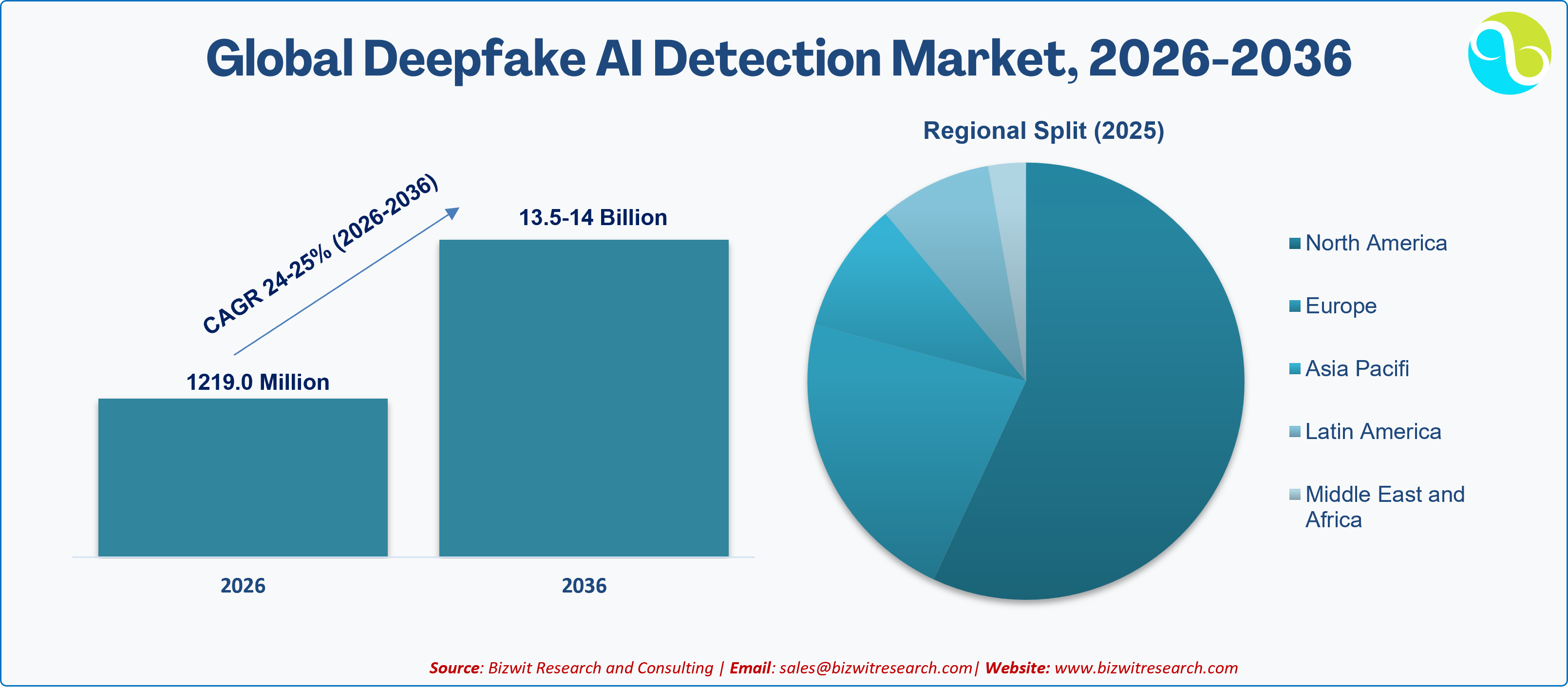
The rapid proliferation of deepfake content across social media platforms, financial systems, political campaigns, and enterprise communication channels has significantly stepped up demand for advanced detection technologies. Organizations are increasingly being forced to roll out AI-powered verification tools to safeguard brand reputation, prevent fraud, and comply with emerging regulatory mandates. Financial institutions, governments, and media houses are leaning into deepfake detection solutions to screen digital assets, validate identities, and protect sensitive communications from malicious manipulation. At the same time, advancements in machine learning, computer vision, and voice biometrics are opening up new avenues for solution providers to scale accuracy and reduce false positives. Nevertheless, the arms race between deepfake generation and detection technologies remains intense, with evolving threat sophistication posing ongoing challenges throughout the forecast period of 2025–2035.
Global Deepfake AI Detection Market Witnessing Rapid Growth Driven by Video Threats, Cloud Adoption, and Regional Expansion
Video deepfake detection is expected to dominate the market over the forecast period, as manipulated video content represents the most visible and damaging form of synthetic media. High-profile cases involving political misinformation, executive impersonation, and social engineering attacks have accelerated investments in video authentication technologies. These solutions are being deployed extensively across media organizations, social platforms, and government agencies to flag altered content before it goes viral. While image and voice detection solutions are gaining traction, video detection remains the cornerstone of most enterprise-grade deepfake defense strategies.
Cloud Adoption and Enterprise Demand Fuel Growth in Deepfake Detection Industry
From a revenue perspective, cloud-based deployment models currently lead the Global Deepfake AI Detection Market. Cloud platforms allow organizations to scale detection capabilities rapidly, integrate APIs seamlessly into existing workflows, and process large volumes of content in real time. Large enterprises account for the majority of current market revenues, driven by their higher exposure to reputational and financial risks and their greater capacity to invest in advanced security solutions. However, SMEs are emerging as a fast-growing segment, increasingly adopting subscription-based, cloud-delivered detection tools to protect digital operations without heavy upfront infrastructure investments.
North America Leads While Asia Pacific Emerges as Fastest-Growing Deepfake Detection Market
The key regions considered for the Global Deepfake AI Detection Market include North America, Europe, Asia Pacific, Latin America, and the Middle East & Africa. North America dominates the market, supported by strong AI research ecosystems, early regulatory action, and high adoption across BFSI, defense, and media sectors. Europe follows closely, driven by stringent data protection laws and increasing focus on digital content authenticity. Asia Pacific is anticipated to witness the fastest growth during the forecast period, fueled by rapid digitalization, expanding social media usage, and rising investments in AI-driven security solutions across countries such as China, India, Japan, and South Korea. Latin America and the Middle East & Africa are steadily gaining traction as awareness around deepfake threats and digital fraud continues to rise.
Report Attributes | Details |
Market Size in 2025 | USD 1219 MIllion |
Market Size by 2036 | USD 13.5-14 Billion |
CAGR | CAGR of 24-25% From 2026 to 2035 |
Base Year | 2025 |
Forecast Period | 2026-2035 |
Historical Data | 2022-2024 |
Key Segments |
|
Regional Analysis/Coverage | North America (US, Canada), Europe (Germany, UK, France, Italy, Spain, Rest of Europe), Asia Pacific (China, India, Japan, South Korea, Australia, ASEAN Countries, Rest of Asia Pacific), Middle East & Africa (UAE, Saudi Arabia, Qatar, South Africa, Rest of Middle East & Africa), Latin America (Brazil, Argentina, Mexico, Colombia, Rest of Latin America). |
Company Profiles | Microsoft Corporation, Google LLC, Meta Platforms, Inc., Amazon Web Services, Inc., IBM Corporation, Intel Corporation, Sensity AI, Reality Defender, Deepware, Truepic, Inc., CyberLink Corp. BioID GmbH Onfido Ltd. FacePhi Biometría S.A. Veridas |
The objective of the study is to define market sizes of different segments and countries in recent years and to forecast their values for the coming years. The report is structured to combine qualitative insights with quantitative analysis, capturing the evolving threat landscape, technological innovation, and regulatory developments shaping the market. It provides detailed insight into growth drivers, challenges, and emerging opportunities, along with an in-depth evaluation of the competitive landscape and solution portfolios of leading market participants.
Key Takeaways
- Market Estimates & Forecast for 10 years from 2025 to 2035.
- Annualized revenues and regional-level analysis for each market segment.
- Comprehensive geographical analysis with country-level insights.
- Competitive landscape assessment covering major industry players.
- Strategic analysis of key business initiatives and future growth pathways.
- Evaluation of the competitive structure of the market.
- Detailed demand-side and supply-side market analysis.