Global CAR T-Cell Therapy Market Size Study and Forecast, 2025–2035
Global CAR T-Cell Therapy Market Size Study and Forecast, 2025–2035

Report Summary
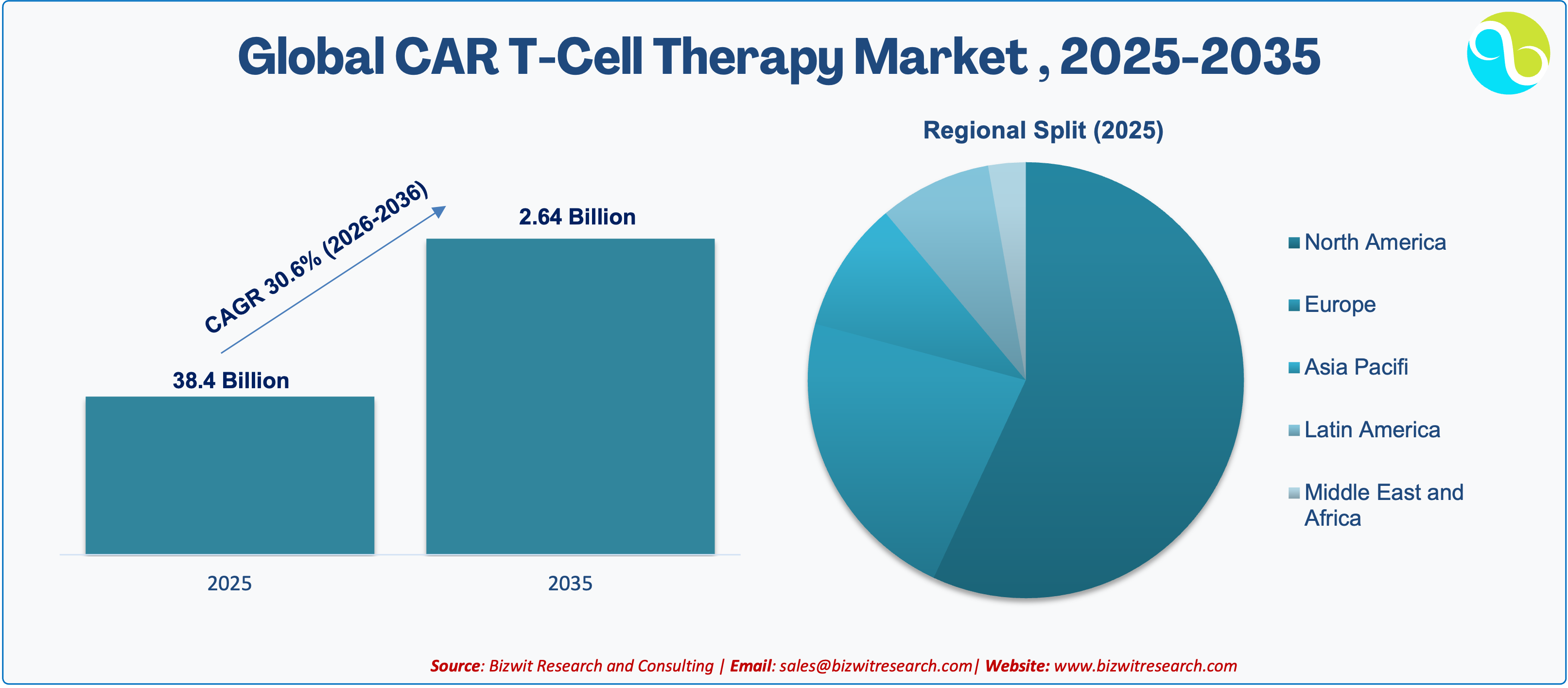
The global CAR T-Cell Therapy market size is valued at USD 4.93 billion in 2024 and is predicted to reach USD 30.62 billion in 2035
Category: Healthcare and Life Sciences
Report Code: BIZ260548
Pages: 293
Published:
Pricing
- Single User License: $4950
- Enterprise License: $6250
- Excel Data Pack: $2950
Report Details
Market Definition, Recent Developments and Industry Trends
Chimeric Antigen Receptor (CAR) T-cell therapy represents a transformative class of personalized immunotherapies designed to genetically engineer a patient’s own T-cells to recognize and eliminate cancer cells. The global CAR T-Cell Therapy market encompasses commercially approved autologous CAR T-cell products, associated manufacturing and processing services, hospital-based administration infrastructure, and supportive care protocols. Core applications are currently concentrated in hematologic malignancies, including lymphoma, leukemia, and multiple myeloma, with leading marketed products such as Abecma, Breyanzi, Carvykti, and Kymriah shaping the competitive landscape. The ecosystem includes biopharmaceutical innovators, contract development and manufacturing organizations (CDMOs), specialized oncology centers, regulators, and reimbursement bodies.
In recent years, the market has evolved from early regulatory approvals toward broader label expansions, improved manufacturing efficiencies, and strategic partnerships to address scalability constraints. Accelerated regulatory pathways, orphan drug incentives, and increasing clinical evidence supporting durable remission rates have strengthened physician and payer confidence. Looking ahead to 2025–2035, the market is expected to witness continued pipeline maturation, expansion into earlier lines of therapy, and progressive integration of next-generation constructs, including dual-target and allogeneic platforms, thereby reshaping oncology treatment paradigms.
Market Determinants
The increasing global burden of lymphoma, leukemia, and multiple myeloma is a primary demand driver. As relapse rates remain significant with conventional chemotherapy and stem cell transplantation, CAR T-cell therapy offers a high-efficacy alternative for refractory and relapsed cases. This unmet clinical need underpins sustained commercial growth and premium pricing power.
Robust long-term survival data and positive outcomes in second-line settings are accelerating regulatory approvals and label expansions. Movement into earlier lines of therapy materially enlarges the addressable patient pool, improving revenue visibility and long-term market sustainability.
Manufacturing complexity and vein-to-vein turnaround times have historically constrained scalability. Investments in automation, decentralized manufacturing models, and improved cryopreservation techniques are gradually reducing costs and enhancing throughput. These operational improvements are critical for margin expansion and global penetration.
Accelerated approvals, breakthrough therapy designations, and supportive reimbursement frameworks in major markets provide commercial viability. Innovative payment models, including outcomes-based reimbursement, are helping mitigate high upfront therapy costs and fostering payer adoption.
Despite strong efficacy, CAR T-cell therapies remain capital-intensive, with total treatment costs often exceeding several hundred thousand dollars. Additionally, administration requires specialized facilities and trained personnel to manage cytokine release syndrome and neurotoxicity. These barriers limit access in low- and middle-income regions and constrain rapid global scale-up.
The emergence of bispecific antibodies and next-generation cell therapies introduces competitive pressure. While CAR T remains highly effective, comparative efficacy, safety, and cost profiles will shape long-term positioning in the oncology treatment algorithm.
Opportunity Mapping Based on Market Trends
Next-Generation and Allogeneic CAR Platforms
The transition from autologous to allogeneic (“off-the-shelf”) CAR T-cell therapies presents a significant cost and scalability opportunity. Companies investing in universal donor platforms stand to reduce manufacturing lead times and broaden patient accessibility.
Rising oncology incidence, improving healthcare infrastructure, and regulatory harmonization in Asia Pacific create fertile ground for expansion. Strategic local manufacturing partnerships and licensing agreements can unlock high-growth markets with relatively lower competitive intensity.
Clinical trials evaluating CAR T-cell therapy in earlier treatment settings could redefine standard-of-care protocols. Successful penetration into second-line or even frontline therapy for select indications would materially expand revenue pools.
Given the need for close patient monitoring post-infusion, digital health tools and remote toxicity management platforms represent ancillary growth avenues. Integration of data-driven care pathways can improve outcomes and strengthen provider relationships.
Report Attributes | Details |
Market Size in 2025 | USD 4.93 Billion |
Market Size by 2035 | USD 30.62 Billion |
CAGR | CAGR of 18.06% From 2026 to 2035 |
Base Year | 2025 |
Forecast Period | 2026-2035 |
Historical Data | 2022-2024 |
Key Segments |
|
Regional Analysis/Coverage | North America (US, Canada), Europe (Germany, UK, France, Italy, Spain, Rest of Europe), Asia Pacific (China, India, Japan, South Korea, Australia, ASEAN Countries, Rest of Asia Pacific), Middle East & Africa (UAE, Saudi Arabia, Qatar, South Africa, Rest of Middle East & Africa), Latin America (Brazil, Argentina, Mexico, Colombia, Rest of Latin America). |
Company Profiles | Bristol, Novartis AG, Gilead Sciences Inc., JW Therapeutics Ltd., bluebird bio Inc., Merck and Co. Inc., Sangamo Therapeutics, Sorrento Therapeutics Inc., GSK plc. |
Lymphoma currently dominates the disease indication segment due to earlier approvals, broader label coverage, and a sizable patient base. However, multiple myeloma is expected to witness accelerated growth, supported by strong clinical outcomes and increasing adoption of products such as Carvykti and Abecma in relapsed settings.
By product, first-generation approvals established early market presence, but next-wave products with improved safety profiles and higher response rates are capturing incremental share. While hospitals remain the dominant end-use setting owing to advanced care infrastructure, specialty cancer centers are expected to expand rapidly as outpatient administration capabilities and expertise improve.
Regional Market Assessment
North America leads the global CAR T-Cell Therapy market, supported by strong biopharmaceutical innovation, favorable reimbursement frameworks, and advanced oncology infrastructure. The United States, in particular, benefits from early regulatory approvals and substantial RandD investment, positioning the region as a commercialization hub.
Europe demonstrates steady growth driven by regulatory harmonization under centralized approval pathways and expanding reimbursement coverage across Western European nations. However, cost-containment pressures and cross-country pricing variability may moderate expansion compared to North America.
Asia Pacific is expected to record the fastest growth rate over the forecast period. Increasing cancer prevalence, growing investment in biotechnology, and supportive regulatory reforms in countries such as China and Japan are strengthening regional capabilities in both development and commercialization.
The LAMEA region presents emerging opportunities, particularly in select Middle Eastern markets investing in advanced oncology centers. However, limited reimbursement frameworks and infrastructure gaps in parts of Latin America and Africa constrain immediate scalability.
Recent Developments
- March 2024: A leading biopharmaceutical company announced expanded manufacturing capacity for CAR T-cell therapy in North America, aiming to reduce turnaround times and address rising demand. This move enhances supply chain resilience and supports revenue scalability.
- September 2023: Regulatory authorities approved expanded indications for a major CAR T product in second-line lymphoma treatment. This milestone significantly enlarges the eligible patient population and reinforces clinical adoption.
- January 2024: Strategic collaboration between a CAR T developer and a CDMO to advance allogeneic pipeline candidates. The partnership underscores industry focus on cost reduction and next-generation innovation.
Critical Business Questions Addressed
- What is the long-term value creation potential of the CAR T-Cell Therapy market through 2035?
The report evaluates revenue expansion driven by label extensions, geographic penetration, and technology innovation.
- Which disease indications and products offer the strongest growth prospects?
Segment-level analysis identifies high-growth pockets, particularly in multiple myeloma and earlier-line lymphoma settings.
- How will manufacturing advancements influence margins and scalability?
Operational efficiencies and automation are assessed for their impact on cost structure and competitive positioning.
- What regional strategies should companies prioritize?
The study highlights differentiated regional entry models, including partnerships, local manufacturing, and reimbursement negotiation strategies.
- How will competitive therapies impact long-term market dynamics?
The report analyzes pipeline competition and substitution risks from alternative immunotherapies.
Beyond the Forecast
CAR T-cell therapy is transitioning from a niche salvage therapy to a potential cornerstone of hematologic cancer treatment. The next decade will be defined by scalability, cost rationalization, and clinical expansion into earlier treatment lines.
Market leaders will be those that combine therapeutic innovation with manufacturing excellence and strategic geographic expansion. As ecosystem integration deepens, business models are expected to evolve toward platform-based oncology solutions rather than single-asset commercialization strategies.